
The artworks displayed on JAODB are not for sale
 |  |
 |
 |
 |
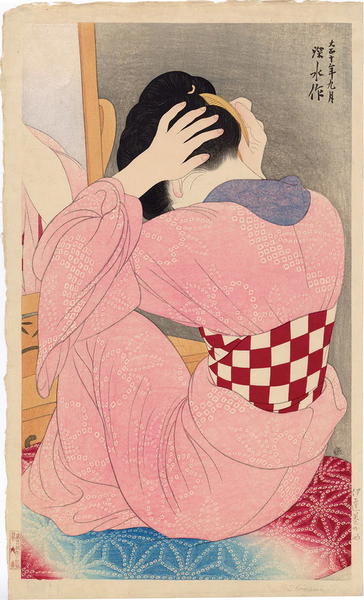 |
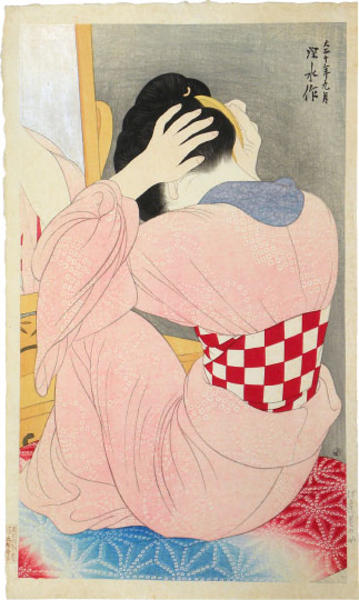
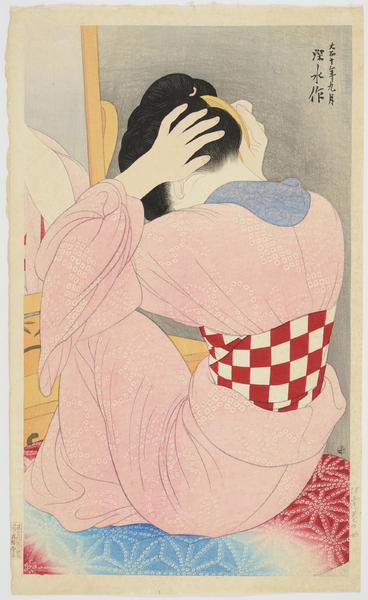
| Notes (1st edition) | Ito Shinsui ???? Artist: Ito Shinsui (1898-1972) Title: Woman Wearing an Under-sash ????? (Datemaki no Onna) Date: 1921 Dimensions: ôban 43.6 x 26 cm Publisher: Watanabe Shozaburo Width Item: 10.4 inches = 26.5 cm Height Item: 17.3 inches = 44.0 cm Literature: Allen Hockley editor, The Women of Shin Hanga: The Judith and Joseph Barker Collection of Japanese Prints, 2013, p. 172, pl 36; Kato Junzo, Kindai Nihon hanga taikei, 1975-76, Vol. 1, pl. 180. Amy Newland and Chris Uhlenbeck, Ukiyo-e to Shin Hanga, 1990, p. 215. Tadasu Watanabe, Ito Shinsui: All the Woodblock Prints, 1992, p. 55, pl. 24. Amy Newland Reigle and Hamanaka Shinji, The Female Image, 2000, p. 53, pl. 31; Amy Newland Reigle, gen. ed., Printed to Perfection, 2004, p. 100, pl. 87.; See Smithsonian National Museum of Asian Art | ||||
| Publisher (this edition): | Watanabe Shozaburo | Watanabe Shozaburo | Watanabe Shozaburo | Watanabe Shozaburo | Watanabe Shozaburo |
| Date of this item: | |||||
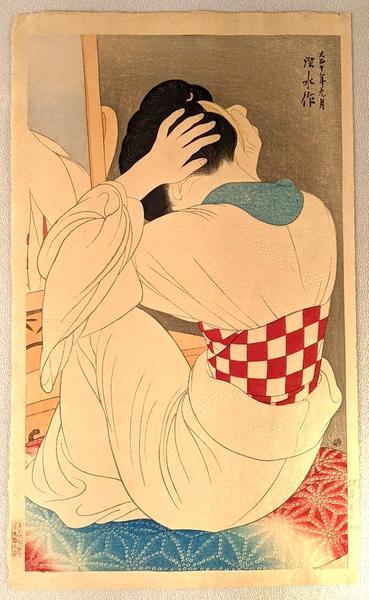
| Notes (this edition) These notes were written by the original owner/seller/auctioner of the item and may be inaccurate.: | Ito Shinsui, 1898-1972 Woman Wearing an Under-Sash (Datemaki no Onna) Dated and signed, Taisho junen kugatsu Shinsui saku, (Taisho 10 [1921], 9th month, by Shinsui), with publisher's round circular Watanabe seal at right. The title, Datemaki no onna, on the lower right margin, and hand-numbered limited edition seal on lower left margin, Nihyaku mai kagiri zeppan, dai gojuichi ban (200 limited edition, number 51), ca. 1921 dai oban tate-e 17 1/8 by 10 1/4 in., 43.6 by 26 cm References: Kato Junzo, Kindai Nihon hanga taikei, 1975-76, Vol. 1, pl. 180 Amy Newland and Chris Uhlenbeck, Ukiyo-e to Shin Hanga, 1990, p. 215 Tadasu Watanabe, Ito Shinsui: All the Woodblock Prints, 1992, p. 55, pl. 24 Amy Newland Reigle and Hamanaka Shinji, The Female Image, 2000, p. 53, pl. 31 Amy Newland Reigle, gen. ed., Printed to Perfection, 2004, p. 100, pl. 87 |
This particular print (edition 96) was sold (2025, July) as a "white komono colour-variant", however I beleve this to be simply a badly faded example of the pink Kimono scene. Remnants of the pink are visible (but only just). I have not seen even a single example of another white kimono colour variant. It was previously sold at Bukowski's Auction with the condition report: "Faded". Name: Shinsui Ito Title: Woman Wearing an Under-sash Very Rare Color Variant(??). Limited edition. Before Kanto Earthquake. Description "Datemaki no Onna" (Woman wearing an under-sash), which was published in 1921. A very rare, pre-earthquake design. This impression is the rarely seen color variant with embossed "shibori" patterns on white kimono instead of regularly seen pink colored kimono. (The 3rd and the 4th images show the embossing). It is printed without the pink color block for the kimono and skin tones - No pigment loss or degradation is visible under magnification. The paper exhibits light, even age-toning, consistent with the print's age. The sheet retains full margins and shows only minor traces of previous mounting on the original folder from the publisher in upper margin corner on verso. Overall, a rare and beautifully preserved impression of one of Shinsui's iconic early bijin-ga designs. Edition number in Japanese, 96/200, is stamped on the left margin. Watanabe 6 mm round seal on lower right. (Most of Shinsui's pre-war bijin prints have the simple 6 mm round seal, instead of the large, rectangular stamp). Signature: Shinsui. Seal: Artist's red seal. Dated: 1921, September. Publisher: Watanabe. Technique: Woodblock print Numbered: 96/200 Literature Newland, Amy R.; and S. Hamanaka, "The Female Image: 20th Century Prints of Japanese Beauties", Leiden: Hotei, 2000, ISBN 90 74822 20 7, - Pg 53, pl 31. Width Item: 10.4 inches = 26.5 cm Height Item: 17.3 inches = 44.0 cm |
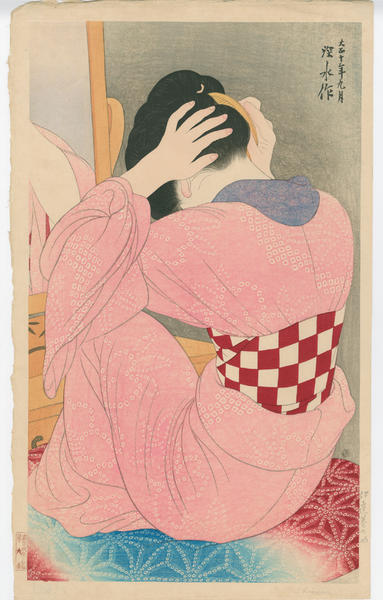
TITLE: Beauty Wearing an Under Sash 9/200 DATE: 1921 SIZE: 17.125 x 10.25 MEDIUM: Woodblock Print PUBLISHER: Watanabe CONDITION: Fine impression, color and condition. |
Ito Shinsui ????: Woman Wearing an Under-sash ????? Artist: Ito Shinsui (1898-1972) Title: Woman Wearing an Under-sash ????? (Datemaki no Onna) Date: 1921 Signature: Shinsui. Seal: Artist's red seal. A beauty is seen at her toilette affixing a hair comb in a masterful composition that shows her facing away from us, emphasizing the intimacy of the moment. A modern twist of the scene of a woman at her mirror, the eye here is drawn to the boldly checkered datemaki sash that was worn to secure an under kimono. Perhaps because this accessory was never seen by the public, it accentuates the privacy of this moment. Its tension on her slender waist is emphasized, and we also get a glimpse of her neck as she secures a comb, the neck being considered a highly erotic space by the Japanese. The mirror at left has a mica finish, and the beautiful bokashi effect on the shibori-patterned cushion gives her a sense of floating on air. The pink on her skin is still strongly apparent, indicating that there has been no fading at all. A scarce, pre-earthquake design in perfectly unfaded condition that is considered one of the artist’s best designs. From the first and only edition; sealed , numbered nine out of 200. Unusual elements include the limited edition seal being placed on the front (rather than the verso) and the title of the print being printed in soft grey in the left lower margin. Condition: Excellent impression, color and condition. Dimensions: ôban 43.6 x 26 cm Publisher: Watanabe Shozaburo Literature: Allen Hockley editor, The Women of Shin Hanga: The Judith and Joseph Barker Collection of Japanese Prints, 2013, p. 172, pl 36; Kato Junzo, Kindai Nihon hanga taikei, 1975-76, Vol. 1, pl. 180. Amy Newland and Chris Uhlenbeck, Ukiyo-e to Shin Hanga, 1990, p. 215. Tadasu Watanabe, Ito Shinsui: All the Woodblock Prints, 1992, p. 55, pl. 24. Amy Newland Reigle and Hamanaka Shinji, The Female Image, 2000, p. 53, pl. 31; Amy Newland Reigle, gen. ed., Printed to Perfection, 2004, p. 100, pl. 87.; See Smithsonian National Museum of Asian Art |
|