| | |
| Artist: | Shinsui Ito (1898-1972) — 伊東深水 |
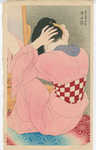
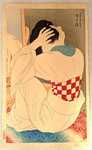
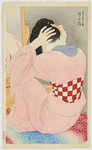
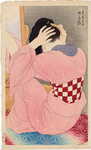
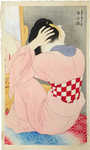
| Title: | Beauty Wearing an Under Sash |
| Series: | |
| Date of first edition?: | 1921 |
| Publisher (first edition)?: | Watanabe Shozaburo — 渡辺 |
| Publisher (this edition)?: | Watanabe Shozaburo — 渡辺 |
| Medium (first edition): | Woodblock |
|
Medium (this edition): | Woodblock |
| Format (first edition): | Large Oban
|
| Format (this edition): | Large Oban |
| DB artwork code: | 48092 |
| Notes (first edition)?: |
Ito Shinsui 伊東深水
Artist: Itō Shinsui (1898-1972)
Title: Woman Wearing an Under-sash 伊達巻の女 (Datemaki no Onna)
Date: 1921
Dimensions: ôban 43.6 x 26 cm
Publisher: Watanabe Shozaburo
Width Item: 10.4 inches = 26.5 cm
Height Item: 17.3 inches = 44.0 cm
Literature: Allen Hockley editor, The Women of Shin Hanga: The Judith and Joseph Barker Collection of Japanese Prints, 2013, p. 172, pl 36; Kato Junzo, Kindai Nihon hanga taikei, 1975-76, Vol. 1, pl. 180. Amy Newland and Chris Uhlenbeck, Ukiyo-e to Shin Hanga, 1990, p. 215. Tadasu Watanabe, Ito Shinsui: All the Woodblock Prints, 1992, p. 55, pl. 24. Amy Newland Reigle and Hamanaka Shinji, The Female Image, 2000, p. 53, pl. 31; Amy Newland Reigle, gen. ed., Printed to Perfection, 2004, p. 100, pl. 87.; See Smithsonian National Museum of Asian Art |
|
| Notes (this edition)?: |
| The following information was taken from the original web listing of this artwork. Note that there may be some inaccuracies:
This particular print (edition 96) was sold (2025, July) as a "white komono colour-variant", however I beleve this to be simply a badly faded example of the pink Kimono scene. Remnants of the pink are visible (but only just). I have not seen even a single example of another white kimono colour variant. It was previously sold at Bukowski's Auction with the condition report: "Faded".
Name: Shinsui Ito
Title: Woman Wearing an Under-sash
Very Rare Color Variant(??). Limited edition. Before Kanto Earthquake.
Description
"Datemaki no Onna" (Woman wearing an under-sash), which was published in 1921. A very rare, pre-earthquake design.
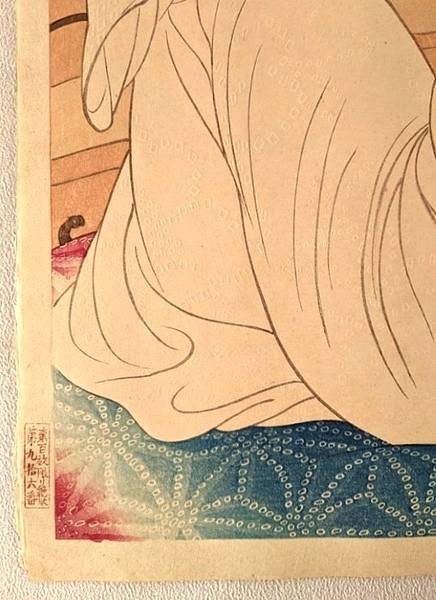
This impression is the rarely seen color variant with embossed "shibori" patterns on white kimono instead of regularly seen pink colored kimono. (The 3rd and the 4th images show the embossing).
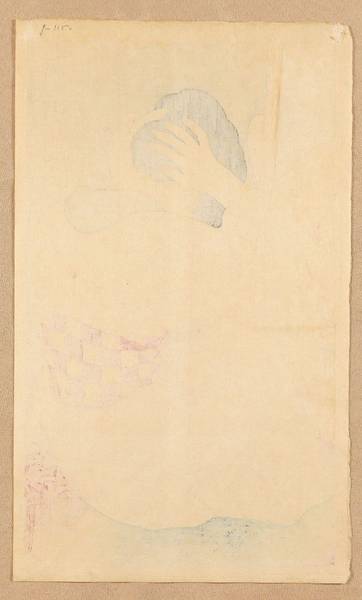
It is printed without the pink color block for the kimono and skin tones - No pigment loss or degradation is visible under magnification. The paper exhibits light, even age-toning, consistent with the print's age. The sheet retains full margins and shows only minor traces of previous mounting on the original folder from the publisher in upper margin corner on verso.
Overall, a rare and beautifully preserved impression of one of Shinsui's iconic early bijin-ga designs.
Edition number in Japanese, 96/200, is stamped on the left margin. Watanabe 6 mm round seal on lower right. (Most of Shinsui's pre-war bijin prints have the simple 6 mm round seal, instead of the large, rectangular stamp).
Signature: Shinsui.
Seal: Artist's red seal.
Dated: 1921, September.
Publisher: Watanabe.
Technique: Woodblock print
Numbered: 96/200
Literature
Newland, Amy R.; and S. Hamanaka, "The Female Image: 20th Century Prints of Japanese Beauties", Leiden: Hotei, 2000, ISBN 90 74822 20 7, - Pg 53, pl 31.
Width Item: 10.4 inches = 26.5 cm
Height Item: 17.3 inches = 44.0 cm |
|
| Artist Bio: |
Ito Shinsui - Born in Tokyo, Ito Shinsui studied Japanese painting and began designing woodblock prints for the publisher Watanabe Shozaburo in 1916, with whom he collaborated until 1960. He is best known for his lovely shin hanga images of beautiful women. These elegant and refined beauties are drawn with graceful line work and softly coloured backgrounds. Recognized for his artistic achievements, the Japanese government declared Shinsui an "Intangible Cultural Property" in 1952, and he received the "Order of the Rising Sun" in 1970.
【伊東 深水(いとう しんすい)】
明治31年(1898年)2月4日 - 昭和47年(1972年)5月8日)
大正・昭和期の日本画家。本名、一(はじめ)。
≪経歴≫
1898年 東京深川に生まれる
1907年 小学校3年で中退、以後は看板屋に奉公し住み込みで働く
1908年 職工となり東京印刷の活字工になる。日本画家の中山秋湖に日本画を習う
1910年 第10回巽画会展速水御舟の「小春」に深く感動し、日本画家の道を決意する
1911年 結成素明の紹介をえて鏑木清方へ入門。「深水」の号を与えられ、夜間学校で苦学しながらも精進する、14歳
1912年 第12回巽画会展に『のどか』が初入選
1913年 巽画会1等褒状
1914年 再興第1回院展に『桟敷の女』が入選、東京印刷を退社する
1915年 第9回文展に『十六の女』が初入選
1916年 渡辺版画店から第1作『対鏡』を発表、川瀬巴水らと分業による新版画運動を推進、浮世絵版画の系統をひく木版画会に大きな足跡を残した。
1919年 好子と結婚し長男と二男をもうける
1922年 平和記念東京博覧会で『指』が2等銀牌
1927年 大井町に深水画塾設立 第8回帝展で「羽根の音」が特選を受賞。帝展無監査となる。
1932年 人物画の再興を目指し、山口蓬春ら「青々会」設立
1935年 料亭「勝田」の女将であった勝田麻起子との間に雪会(後の朝丘雪路)をもうける
1939年 山川秀峰らと青衿会を結成。
1943年 召集され海軍報道班員として南方諸島へ派遣、外地で4000枚ものスケッチをする
1945年 長野県小諸市に疎開
1948年 『鏡』で第4回日本芸術院賞受賞
1949年 鎌倉に転居
1950年 白鳥映雪、児玉希望、奥田元宋、佐藤太清等と日月社を結成、後進の育成にあたる
1958年 日本芸術院会員に推挙
1969年 日展顧問となる。
1970年 勲3等旭日中緩章を受賞。
1972年 癌により5月8日没 享年74 墓所は品川区上大崎の隆崇院 法名は画光院一誉明澄深水大居士 |
|